> For the complete documentation index, see [llms.txt](https://docs.parallels.com/landing/llms.txt). Markdown versions of documentation pages are available by appending `.md` to page URLs; this page is available as [Markdown](https://docs.parallels.com/landing/pd-ag/parallels-desktop-for-mac-enterprise-edition-features/deprecated-using-configuration-profiles/creating-a-configuration-profile.md).
# Creating a Configuration Profile
To create a configuration profile:
1. Log in to your Parallels business account.
2. In the **Parallels Desktop for Mac Enterprise Edition** product card, click **Registered Computers**.
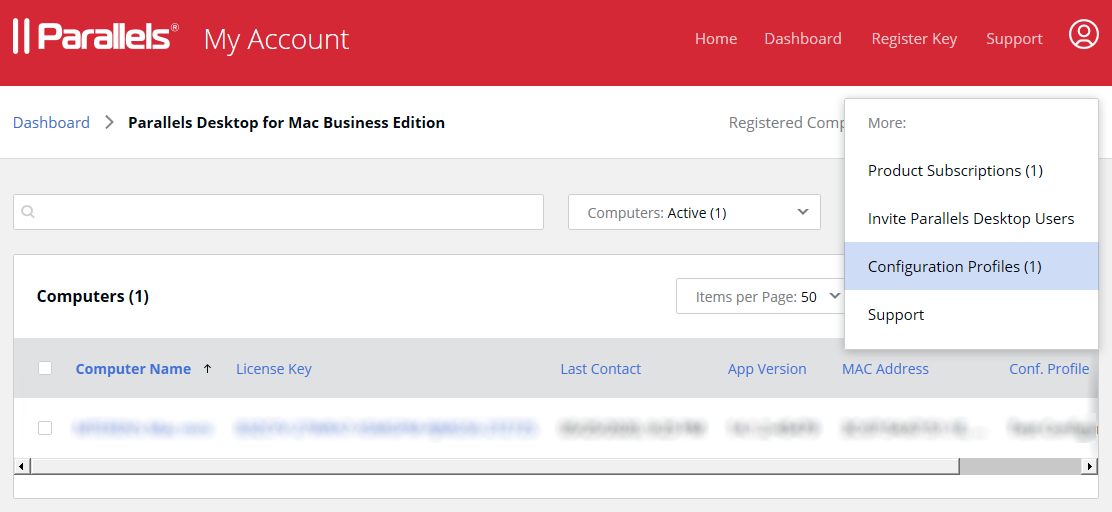
3. Click the More item in the main menu (top right) and choose Configuration Profiles, as shown in the screenshot below.
4. The page listing configuration profiles opens. If you haven't created any profiles yet, the list will be empty.
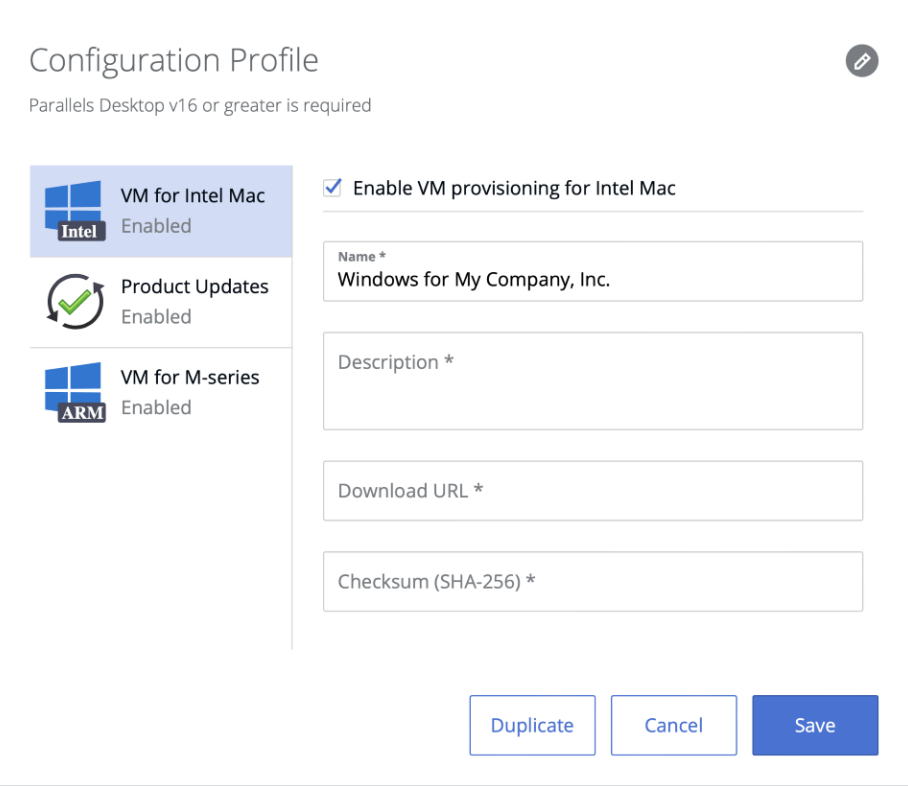
5. Click the **Create Profile** button. A dialog opens where you can configure the profile.
6. To replace the default profile name (top left), simply erase the default name (New Configuration Profile) and type a new one.
7. The payloads are listed in the left pane. To configure a payload, select it and then specify the necessary settings in the right pane. Each payload has the "Enable..." option at the top of the right pane. This option enables or disables a payload but doesn't change or discard the payload settings. When a payload is enabled, it is included in the configuration profile when the profile is applied to Mac computers. When a payload is disabled, it is not included, so Mac computers don't receive it.\
\
For creating the payload (i.e, a virtual machine image), refer to [this page](/landing/pd-ag/provisioning-and-activation-of-parallels-desktop/alternative-deployment-methods/alternative-mass-deployment-via-deployment-package/preparing-the-autodeploy-package/optional-adding-a-virtual-machine/creating-and-uploading-virtual-machine-images.md) of the guide.
8. When done, click **Save** to save the configuration profile.
At this point we will not configure any of the payloads yet and will go straight to applying the configuration profile to a license or sublicense keys (it is allowed to create a profile with all payloads disabled). Once you learn how to create and apply a configuration profile, we'll talk about how to configure and use each individual payload.
---
# Agent Instructions
This documentation is published with GitBook. GitBook is the documentation platform designed so that both humans and AI agents can read, navigate, and reason over technical content effectively. Learn more at gitbook.com.
## Querying This Documentation
If you need additional information that is not directly available in this page, you can query the documentation dynamically by asking a question.
Perform an HTTP GET request on the current page URL with the `ask` query parameter, and the optional `goal` query parameter:
```
GET https://docs.parallels.com/landing/pd-ag/parallels-desktop-for-mac-enterprise-edition-features/deprecated-using-configuration-profiles/creating-a-configuration-profile.md?ask=&goal=
```
`ask` is the immediate question: it should be specific, self-contained, and written in natural language.
`goal` is optional and describes the broader end goal you are ultimately trying to accomplish on behalf of the user. GitBook uses it to tailor the answer towards what is most useful for that goal.
The response will contain a direct answer to the question and relevant excerpts and sources from the documentation.
Use this mechanism when the answer is not explicitly present in the current page, you need clarification or additional context, or you want to retrieve related documentation sections.