> For the complete documentation index, see [llms.txt](https://docs.parallels.com/landing/llms.txt). Markdown versions of documentation pages are available by appending `.md` to page URLs; this page is available as [Markdown](https://docs.parallels.com/landing/pdfm-ug/parallels-desktop-for-mac-27-users-guide/advanced-topics/using-other-operating-systems-on-your-mac/customizing-the-keyboard-for-a-guest-os.md).
# Customizing the Keyboard for a Guest OS
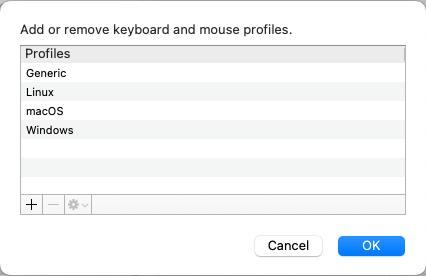
By default, Parallels Desktop contains four profiles that represent sets of key combinations typical for the following OSs:
* Windows
* Linux
* macOS
* Generic (for other guest OSs)
When you create or register a virtual machine, one of these profiles, depending on the guest operating system, is assigned to the machine by default. You can create your own profile and assign it to your virtual machines.
To create a custom keyboard profile or edit the existing profiles:
1. Do one of the following:
* Click the Parallels Desktop icon in the menu bar and choose **Preferences**.
* Right-click the Parallels Desktop icon in the Dock and choose **Preferences**.
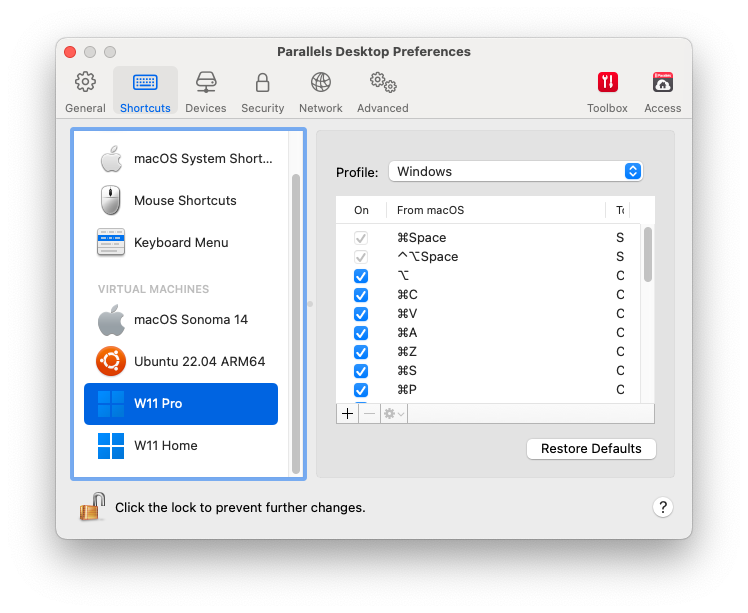
2. Click **Shortcuts**.
3. Select a virtual machine from the sidebar, click the **Profile** menu, and select **Edit profiles list**.
4. Do one of the following:
* To add a new profile, click the **Add** button. Specify the new profile name and select the base profile from the list. After the profile is created, you can submit the changes by clicking **OK**. Then select this new profile in the **Profile** list and configure its shortcuts.
* To remove one of the existing custom profiles, select it and click the **Remove** button.
* To duplicate or rename one of the existing profiles, select this profile, click the **Settings** button, and select the corresponding action from the menu.
{% hint style="info" %}
**Note:** You can rename or remove your custom profiles only.
{% endhint %}
In the **Shortcuts** pane of Parallels Desktop Preferences, you can also assign profiles to your virtual machines.
To change a profile assigned to a virtual machine, select a virtual machine and choose a profile from the **Profile** menu.
---
# Agent Instructions
This documentation is published with GitBook. GitBook is the documentation platform designed so that both humans and AI agents can read, navigate, and reason over technical content effectively. Learn more at gitbook.com.
## Querying This Documentation
If you need additional information that is not directly available in this page, you can query the documentation dynamically by asking a question.
Perform an HTTP GET request on the following URL with the `ask` and `goal` query parameters:
```
GET https://docs.parallels.com/landing/pdfm-ug/parallels-desktop-for-mac-27-users-guide/advanced-topics/using-other-operating-systems-on-your-mac/customizing-the-keyboard-for-a-guest-os.md?ask=&goal=
```
`ask` is the immediate question: it should be specific, self-contained, and written in natural language.
`goal` is what the user is ultimately trying to achieve, the reason they need the answer. Sharing it helps GitBook give you a better, more relevant answer. A goal is most helpful when it describes the outcome the user wants rather than restating the question. For example, with `ask=how do I create an API token`, a goal like `build a script that syncs our docs to a CMS` lets GitBook tailor the answer to that use case.
The response will contain a direct answer to the question and relevant excerpts and sources from the documentation.
Use this mechanism when the answer is not explicitly present in the current page, you need clarification or additional context, or you want to retrieve related documentation sections.