> For the complete documentation index, see [llms.txt](https://docs.parallels.com/landing/llms.txt). Markdown versions of documentation pages are available by appending `.md` to page URLs; this page is available as [Markdown](https://docs.parallels.com/landing/pdfm-ug/parallels-desktop-for-mac-27-users-guide/parallels-desktop-preferences-and-virtual-machine-settings/adding-and-removing-devices/connecting-a-physical-disk-to-a-virtual-machine-as-internal.md).
# Connecting a Physical Disk to a Virtual Machine as Internal
Parallels Desktop allows you to connect a physical hard drive directly to a virtual machine as an internal disk. You can add a physical disk this way either to a new or already existing virtual machine.
### For a New Virtual Machine
To connect a physical drive directly to a new virtual machine, do the following:
1. Connect the external disk to your Mac via USB.
2. When [creating a new virtual machine](/landing/pdfm-ug/parallels-desktop-for-mac-27-users-guide/install-or-import-windows/installing-windows.md), be sure to select **Customize settings before installation**.
3. When the virtual machine configuration opens, select **Hardware**, click the **Add** button, and choose **Hard Disk**.
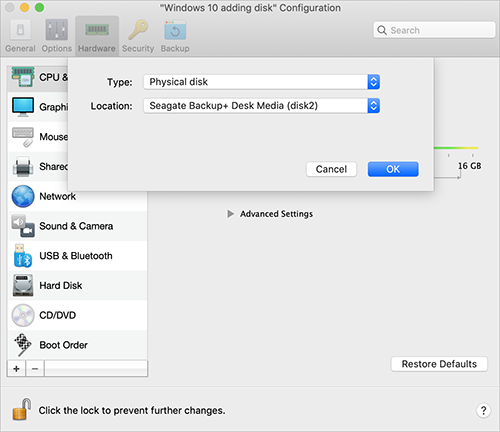
4. Select **Physical disk** from the **Type** menu, select the disk you want to add from the **Location** menu, and click **OK**.
5. The physical disk appears in the virtual machine configuration. If you want to work with its data, leave it as it is. When the virtual machine boots up, you will see this disk next to the other virtual machine disks. If you want to boot the virtual machine from this disk, click **Boot Order** and use the **Up** arrow to move this disk to the very beginning of the **Boot order** list.
Now, when the physical disk is selected as the first boot device, the virtual machine will boot from it.
### For an Existing Virtual Machine
The process of adding a physical disk to an existing virtual machine is very similar to the procedure described above. Do the following:
1. Connect the external disk to your Mac via USB.
2. Make sure your virtual machine is shut down. If it is running, click the Parallels icon in the macOS menu bar and choose **Actions** > **Shut Down**. If the virtual machine is suspended or paused, resume the virtual machine and shut it down.
3. Click the Parallels icon in the macOS menu bar and choose **Configure** to open the virtual machine configuration. Then select **Hardware**, click the **Add** button (+), and choose **Hard Disk**.
4. Other steps are the same as described above (starting from step 4).
---
# Agent Instructions
This documentation is published with GitBook. GitBook is the documentation platform designed so that both humans and AI agents can read, navigate, and reason over technical content effectively. Learn more at gitbook.com.
## Querying This Documentation
If you need additional information that is not directly available in this page, you can query the documentation dynamically by asking a question.
Perform an HTTP GET request on the current page URL with the `ask` query parameter, and the optional `goal` query parameter:
```
GET https://docs.parallels.com/landing/pdfm-ug/parallels-desktop-for-mac-27-users-guide/parallels-desktop-preferences-and-virtual-machine-settings/adding-and-removing-devices/connecting-a-physical-disk-to-a-virtual-machine-as-internal.md?ask=&goal=
```
`ask` is the immediate question: it should be specific, self-contained, and written in natural language.
`goal` is optional and describes the broader end goal you are ultimately trying to accomplish on behalf of the user. GitBook uses it to tailor the answer towards what is most useful for that goal.
The response will contain a direct answer to the question and relevant excerpts and sources from the documentation.
Use this mechanism when the answer is not explicitly present in the current page, you need clarification or additional context, or you want to retrieve related documentation sections.
 Now, when the physical disk is selected as the first boot device, the virtual machine will boot from it.
### For an Existing Virtual Machine
The process of adding a physical disk to an existing virtual machine is very similar to the procedure described above. Do the following:
1. Connect the external disk to your Mac via USB.
2. Make sure your virtual machine is shut down. If it is running, click the Parallels icon in the macOS menu bar and choose **Actions** > **Shut Down**. If the virtual machine is suspended or paused, resume the virtual machine and shut it down.
3. Click the Parallels icon in the macOS menu bar and choose **Configure** to open the virtual machine configuration. Then select **Hardware**, click the **Add** button (+), and choose **Hard Disk**.
4. Other steps are the same as described above (starting from step 4).
---
# Agent Instructions
This documentation is published with GitBook. GitBook is the documentation platform designed so that both humans and AI agents can read, navigate, and reason over technical content effectively. Learn more at gitbook.com.
## Querying This Documentation
If you need additional information that is not directly available in this page, you can query the documentation dynamically by asking a question.
Perform an HTTP GET request on the current page URL with the `ask` query parameter, and the optional `goal` query parameter:
```
GET https://docs.parallels.com/landing/pdfm-ug/parallels-desktop-for-mac-27-users-guide/parallels-desktop-preferences-and-virtual-machine-settings/adding-and-removing-devices/connecting-a-physical-disk-to-a-virtual-machine-as-internal.md?ask=
Now, when the physical disk is selected as the first boot device, the virtual machine will boot from it.
### For an Existing Virtual Machine
The process of adding a physical disk to an existing virtual machine is very similar to the procedure described above. Do the following:
1. Connect the external disk to your Mac via USB.
2. Make sure your virtual machine is shut down. If it is running, click the Parallels icon in the macOS menu bar and choose **Actions** > **Shut Down**. If the virtual machine is suspended or paused, resume the virtual machine and shut it down.
3. Click the Parallels icon in the macOS menu bar and choose **Configure** to open the virtual machine configuration. Then select **Hardware**, click the **Add** button (+), and choose **Hard Disk**.
4. Other steps are the same as described above (starting from step 4).
---
# Agent Instructions
This documentation is published with GitBook. GitBook is the documentation platform designed so that both humans and AI agents can read, navigate, and reason over technical content effectively. Learn more at gitbook.com.
## Querying This Documentation
If you need additional information that is not directly available in this page, you can query the documentation dynamically by asking a question.
Perform an HTTP GET request on the current page URL with the `ask` query parameter, and the optional `goal` query parameter:
```
GET https://docs.parallels.com/landing/pdfm-ug/parallels-desktop-for-mac-27-users-guide/parallels-desktop-preferences-and-virtual-machine-settings/adding-and-removing-devices/connecting-a-physical-disk-to-a-virtual-machine-as-internal.md?ask=