> For the complete documentation index, see [llms.txt](https://docs.parallels.com/landing/llms.txt). Markdown versions of documentation pages are available by appending `.md` to page URLs; this page is available as [Markdown](https://docs.parallels.com/landing/pdfm-ug/v20-de-de/parallels-desktop-for-mac-20-handbuch/einstellungen-von-parallels-desktop-und-virtuellen-maschinen/einstellungen-fur-virtuelle-maschinen/hardware-einstellungen/einstellungen-fur-den-seriellen-port.md).

# Einstellungen für den seriellen Port

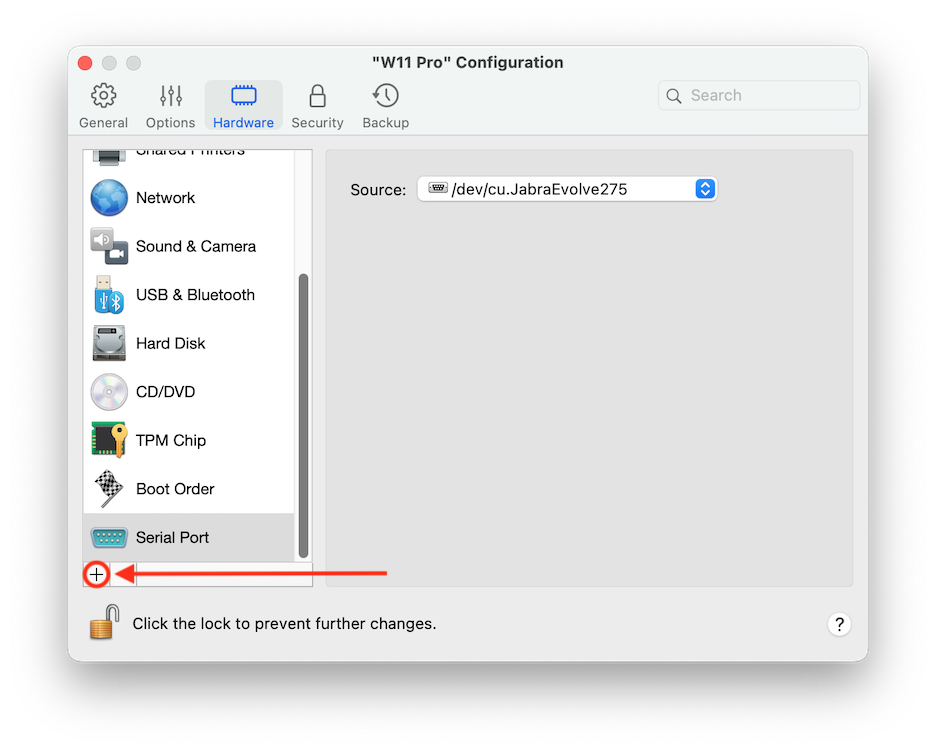
Im Bereich **Serieller Port** können Sie die Einstellungen des seriellen Ports Ihrer virtuellen Maschine anzeigen und konfigurieren.

Um diese Einstellungen zu öffnen, wählen Sie **Aktionen** > **Konfigurieren** > **Hardware** und klicken dann auf **Serieller Port**. Wenn kein serieller Anschluss vorhanden ist, klicken Sie auf **+**, um einen hinzuzufügen, und folgen Sie dann den nachstehenden Anweisungen, um ihn zu konfigurieren.

<figure><img src="https://content.gitbook.com/content/NsNb95o1W6ib95ooxjwW/blobs/lUfOU6bokd2mXXzEO2Dx/image.png" alt="" width="563"><figcaption></figcaption></figure>

<table><thead><tr><th width="114">Option</th><th>Beschreibung</th></tr></thead><tbody><tr><td><strong>Quelle</strong></td><td><p>Im Feld <strong>Quelle</strong> können Sie das Quellgerät angeben, das diesen seriellen Port emuliert:</p><ul><li><strong>Physischer serieller Port</strong>. Zum Verbinden des seriellen Ports der virtuellen Maschine mit einem der vorhandenen seriellen Ports Ihres Macs, wählen Sie den gewünschten Port aus.</li><li><strong>Socket</strong>. Zum Verbinden zweier virtueller Maschinen über die Sockets wählen Sie den gewünschten Socket aus. Falls keine Sockets verfügbar sind, klicken Sie auf <strong>Neuer Socket</strong> und füllen Sie das Feld <strong>Geben Sie einen Socket-Namen an</strong> aus. Außerdem sollten Sie die Funktion der virtuellen Maschine in der Verbindung festlegen, indem Sie die den entsprechenden Eintrag in der Liste <strong>Modus</strong> auswählen. Wenn Sie den Eintrag <strong>Server</strong> auswählen, können Sie diese virtuelle Maschine verwenden, um die andere virtuelle Maschine zu steuern. Wenn Sie den Eintrag <strong>Client</strong> auswählen, können Sie diese virtuelle Maschine von der anderen virtuellen Maschine aus steuern.</li><li><strong>Ausgabedatei</strong>. Zum Verbinden des seriellen Ports der virtuellen Maschine mit einer Ausgabedatei wählen Sie die entsprechende Ausgabedatei oder klicken Sie auf <strong>Ausgabedatei auswählen</strong>, um die gewünschte Ausgabedatei zu finden.</li></ul></td></tr></tbody></table>


---

# Agent Instructions
This documentation is published with GitBook. GitBook is the documentation platform designed so that both humans and AI agents can read, navigate, and reason over technical content effectively. Learn more at gitbook.com.

## Querying This Documentation
If you need additional information that is not directly available in this page, you can query the documentation by asking a question.

Perform an HTTP GET request on the following URL with the `ask` and `goal` query parameters:

```
GET https://docs.parallels.com/landing/pdfm-ug/v20-de-de/parallels-desktop-for-mac-20-handbuch/einstellungen-von-parallels-desktop-und-virtuellen-maschinen/einstellungen-fur-virtuelle-maschinen/hardware-einstellungen/einstellungen-fur-den-seriellen-port.md?ask=<question>&goal=<user_goal>
```

`ask` is the immediate question: it should be specific, self-contained, and written in natural language.
`goal` is what the user is ultimately trying to achieve, the reason they need the answer. Sharing it helps GitBook give you a better, more relevant answer. A goal is most helpful when it describes the outcome the user wants rather than restating the question. For example, with `ask=how do I create an API token`, a goal like `automate deployments from our CI pipeline` lets GitBook tailor the answer to that use case.

The response will contain a direct answer to the question and relevant excerpts and sources from the documentation.

Use this mechanism when the answer is not explicitly present in the current page, you need clarification or additional context, or you want to retrieve related documentation sections.