> For the complete documentation index, see [llms.txt](https://docs.parallels.com/landing/llms.txt). Markdown versions of documentation pages are available by appending `.md` to page URLs; this page is available as [Markdown](https://docs.parallels.com/landing/pdfm-ug/v20-fr-fr/guide-de-lutilisateur-de-parallels-desktop-pour-mac-20/preferences-de-parallels-desktop-et-parametres-de-la-machine-virtuelle/parametres-de-la-machine-virtuelle/parametres-materiels/parametres-de-disque-dur.md).

# Paramètres de disque dur

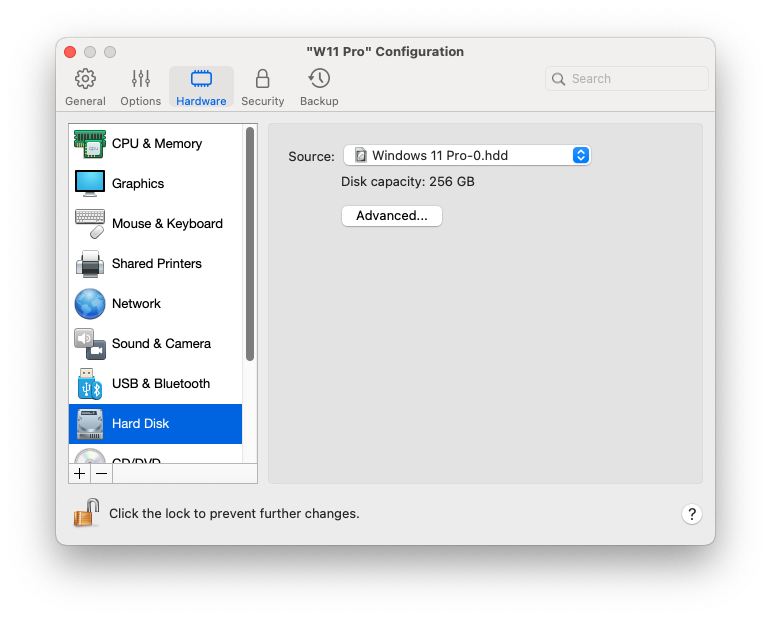
Dans le volet **Disque dur**, vous pouvez afficher et configurer les paramètres du disque dur de la machine virtuelle.

Pour ouvrir ces paramètres, choisissez **Actions** > **Configurer** > **Matériel**, puis cliquez sur **Disque dur**.

<figure><img src="https://content.gitbook.com/content/6L4NL5qFhHsflDi9DiQk/blobs/5wgdK0bWgEXj6qnaYBTE/Screenshot%202024-01-19%20at%2018.31.59.png" alt="" width="563"><figcaption></figcaption></figure>

<table><thead><tr><th width="214">Option</th><th>Description</th></tr></thead><tbody><tr><td><strong>Source</strong></td><td><p>Utilisez ce champ pour spécifier le fichier du disque dur virtuel (<code>.hdd)</code> qui émule le disque dur de la machine virtuelle :</p><ul><li>Pour utiliser la partition Boot Camp, sélectionnez-la dans la liste.</li></ul><p><strong>Remarque :</strong> vous ne pouvez choisir Boot Camp que si vous l'avez sur un Mac avec processeur Intel. Boot Camp n'est pas disponible sur les Mac avec processeur Apple Silicon.</p><ul><li>Pour utiliser un fichier de disque dur virtuel, choisissez-le dans la liste ou cliquez sur <strong>Choisir un fichier image</strong>, puis indiquez le chemin d'accès au fichier image souhaité (<code>.hdd</code>).</li></ul></td></tr><tr><td><strong>Propriétés</strong></td><td>Cliquez sur ce bouton pour modifier la taille du disque dur.</td></tr><tr><td><strong>Emplacement</strong></td><td>Utilisez ce champ pour indiquer le type d'interface de connexion du disque dur. Cette option est réservée aux utilisateurs avancés.</td></tr><tr><td><strong>Activer TRIM</strong></td><td>Dans la plupart des cas, l'espace qu'utilise la machine virtuelle sur votre disque dur augmente au fur et à mesure que vous ajoutez des fichiers et d'autres données, mais ne diminue pas lorsque vous supprimez des données. Pour configurer Parallels Desktop afin qu'il réduise automatiquement l'espace disque, sélectionnez <strong>Activer TRIM</strong>. Cette option peut avoir une incidence sur les performances des disques durs standard (pas des disques SSD).</td></tr></tbody></table>


---

# Agent Instructions
This documentation is published with GitBook. GitBook is the documentation platform designed so that both humans and AI agents can read, navigate, and reason over technical content effectively. Learn more at gitbook.com.

## Querying This Documentation
If you need additional information that is not directly available in this page, you can query the documentation dynamically by asking a question.

Perform an HTTP GET request on the following URL with the `ask` and `goal` query parameters:

```
GET https://docs.parallels.com/landing/pdfm-ug/v20-fr-fr/guide-de-lutilisateur-de-parallels-desktop-pour-mac-20/preferences-de-parallels-desktop-et-parametres-de-la-machine-virtuelle/parametres-de-la-machine-virtuelle/parametres-materiels/parametres-de-disque-dur.md?ask=<question>&goal=<user_goal>
```

`ask` is the immediate question: it should be specific, self-contained, and written in natural language.
`goal` is what the user is ultimately trying to achieve, the reason they need the answer. Sharing it helps GitBook give you a better, more relevant answer. A goal is most helpful when it describes the outcome the user wants rather than restating the question. For example, with `ask=how do I create an API token`, a goal like `build a script that syncs our docs to a CMS` lets GitBook tailor the answer to that use case.

The response will contain a direct answer to the question and relevant excerpts and sources from the documentation.

Use this mechanism when the answer is not explicitly present in the current page, you need clarification or additional context, or you want to retrieve related documentation sections.
