> For the complete documentation index, see [llms.txt](https://docs.parallels.com/landing/llms.txt). Markdown versions of documentation pages are available by appending `.md` to page URLs; this page is available as [Markdown](https://docs.parallels.com/landing/pdfm-ug/v26-es-es/guia-del-usuario-de-parallels-desktop-para-mac-26/uso-de-windows-en-su-mac/visualizacion-de-una-presentacion-en-un-monitor-o-proyector-externo.md).
# Visualización de una presentación en un monitor o proyector externo
Usted puede conectar fácilmente su Mac a un monitor o proyector externo y mostrar una presentación para una aplicación Windows con tan sólo realizar unos pocas acciones de configuración.
Para ello:
1. [Inicie Windows](/landing/pdfm-ug/v26-es-es/guia-del-usuario-de-parallels-desktop-para-mac-26/uso-de-windows-en-su-mac/pasos-iniciales/inicio-de-windows.md) si es que no está en ejecución.
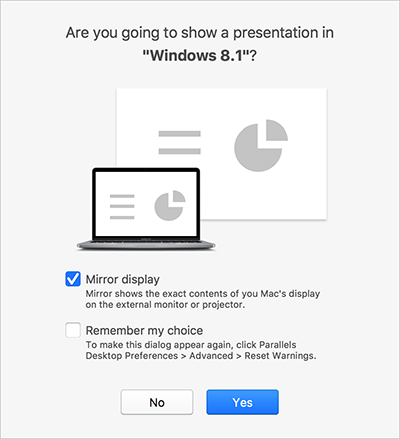
2. Conecte su Mac al monitor o proyector externo siguiendo el procedimiento habitual. Aparecerá un mensaje preguntándole si va a mostrar una presentación.
3. Si en el monitor o proyector externo desea ver los contenidos exactos de la pantalla de su ordenador, seleccione **Duplicar pantalla**.
Si no selecciona **Duplicar**, algunas aplicaciones (por ejemplo, Microsoft Powerpoint) pueden mostrar una vista de presentador en su ordenador y únicamente la presentación en el monitor o proyector externo.
4. Haga clic en **Sí**. Windows cambiará al modo Presentación, que se muestra en pantalla completa tanto en la pantalla del ordenador como en el monitor o proyector externo. Una vez hecho esto, puede iniciar su presentación.
{% hint style="info" %}
**Nota:** Si desea más información acerca de cómo escoger en qué pantalla debe mostrarse la presentación, consulta la ayuda de la aplicación que utiliza para realizar las presentaciones.
{% endhint %}
{% hint style="warning" %}
**¡Importante!** Si está en modo de presentación y cambia la configuración de pantalla en Windows, puede que la presentación deje de funcionar correctamente.
{% endhint %}
---
# Agent Instructions
This documentation is published with GitBook. GitBook is the documentation platform designed so that both humans and AI agents can read, navigate, and reason over technical content effectively. Learn more at gitbook.com.
## Querying This Documentation
If you need additional information that is not directly available in this page, you can query the documentation by asking a question.
Perform an HTTP GET request on the following URL with the `ask` and `goal` query parameters:
```
GET https://docs.parallels.com/landing/pdfm-ug/v26-es-es/guia-del-usuario-de-parallels-desktop-para-mac-26/uso-de-windows-en-su-mac/visualizacion-de-una-presentacion-en-un-monitor-o-proyector-externo.md?ask=&goal=
```
`ask` is the immediate question: it should be specific, self-contained, and written in natural language.
`goal` is what the user is ultimately trying to achieve, the reason they need the answer. Sharing it helps GitBook give you a better, more relevant answer. A goal is most helpful when it describes the outcome the user wants rather than restating the question. For example, with `ask=how do I create an API token`, a goal like `automate deployments from our CI pipeline` lets GitBook tailor the answer to that use case.
The response will contain a direct answer to the question and relevant excerpts and sources from the documentation.
Use this mechanism when the answer is not explicitly present in the current page, you need clarification or additional context, or you want to retrieve related documentation sections.