> For the complete documentation index, see [llms.txt](https://docs.parallels.com/landing/llms.txt). Markdown versions of documentation pages are available by appending `.md` to page URLs; this page is available as [Markdown](https://docs.parallels.com/landing/pdfm-ug/v26-it-it/guida-utente-di-parallels-desktop-per-mac-26/preferenze-di-parallels-desktop-e-impostazioni-della-macchina-virtuale/virtual-machine-settings/impostazioni-hardware/impostazioni-stampante.md).

# Impostazioni stampante

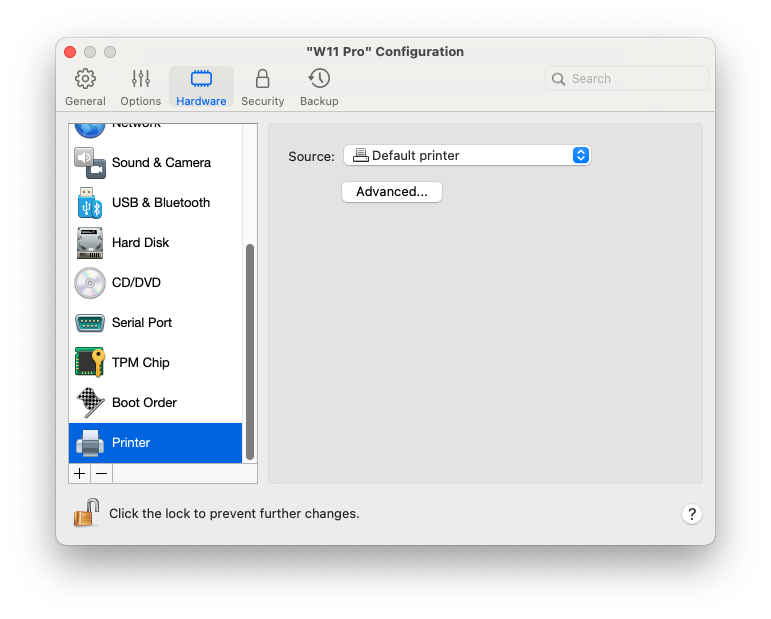
Nel riquadro **Stampante**, è possibile visualizzare e configurare le impostazioni della stampante della macchina virtuale.

Per aprire queste impostazioni, scegli **Azioni** > **Configura** > **Hardware**, quindi fai clic su **Stampante**.

<figure><img src="https://content.gitbook.com/content/0IDly6Lm0kHvRbywMB0B/blobs/lxI87CRXuAXvwHQ4GUZw/Screenshot%202024-01-20%20at%2001.10.50.png" alt="" width="563"><figcaption></figcaption></figure>

<table><thead><tr><th width="137">Opzione</th><th>Descrizione</th></tr></thead><tbody><tr><td><strong>Sorgente</strong></td><td><p>Nel campo <strong>Origine</strong>, specificare il dispositivo di origine che emula questa porta stampante.</p><ul><li><strong>Stampanti</strong>. Nella macchina virtuale è possibile usare qualsiasi stampante connessa al Mac. Selezionare la stampante appropriata dalla lista.</li><li><strong>File di Output</strong>. È possibile emulare la porta stampante della macchina virtuale usando un file di output. Scegli un file di output dalla lista oppure fai clic su <strong>Scegli un file di output</strong> e indica il percorso del file di output desiderato.</li></ul></td></tr><tr><td><strong>Porta</strong></td><td>Nel campo <strong>Porta</strong>, scegli il tipo di porta. Se disponibile, è consigliabile utilizzare <strong>USB</strong>. Collegare una stampante a una macchina virtuale tramite USB garantisce una velocità superiore di trasferimento di dati rispetto al collegamento tramite LPT.</td></tr></tbody></table>


---

# Agent Instructions
This documentation is published with GitBook. GitBook is the documentation platform designed so that both humans and AI agents can read, navigate, and reason over technical content effectively. Learn more at gitbook.com.

## Querying This Documentation
If you need additional information that is not directly available in this page, you can query the documentation by asking a question.

Perform an HTTP GET request on the following URL with the `ask` and `goal` query parameters:

```
GET https://docs.parallels.com/landing/pdfm-ug/v26-it-it/guida-utente-di-parallels-desktop-per-mac-26/preferenze-di-parallels-desktop-e-impostazioni-della-macchina-virtuale/virtual-machine-settings/impostazioni-hardware/impostazioni-stampante.md?ask=<question>&goal=<user_goal>
```

`ask` is the immediate question: it should be specific, self-contained, and written in natural language.
`goal` is what the user is ultimately trying to achieve, the reason they need the answer. Sharing it helps GitBook give you a better, more relevant answer. A goal is most helpful when it describes the outcome the user wants rather than restating the question. For example, with `ask=how do I create an API token`, a goal like `automate deployments from our CI pipeline` lets GitBook tailor the answer to that use case.

The response will contain a direct answer to the question and relevant excerpts and sources from the documentation.

Use this mechanism when the answer is not explicitly present in the current page, you need clarification or additional context, or you want to retrieve related documentation sections.
