> For the complete documentation index, see [llms.txt](https://docs.parallels.com/landing/llms.txt). Markdown versions of documentation pages are available by appending `.md` to page URLs; this page is available as [Markdown](https://docs.parallels.com/landing/pdfm-ug/v26-it-it/guida-utente-di-parallels-desktop-per-mac-26/preferenze-di-parallels-desktop-e-impostazioni-della-macchina-virtuale/virtual-machine-settings/opzioni/impostazioni-web-ed-email.md).

# Impostazioni Web ed Email

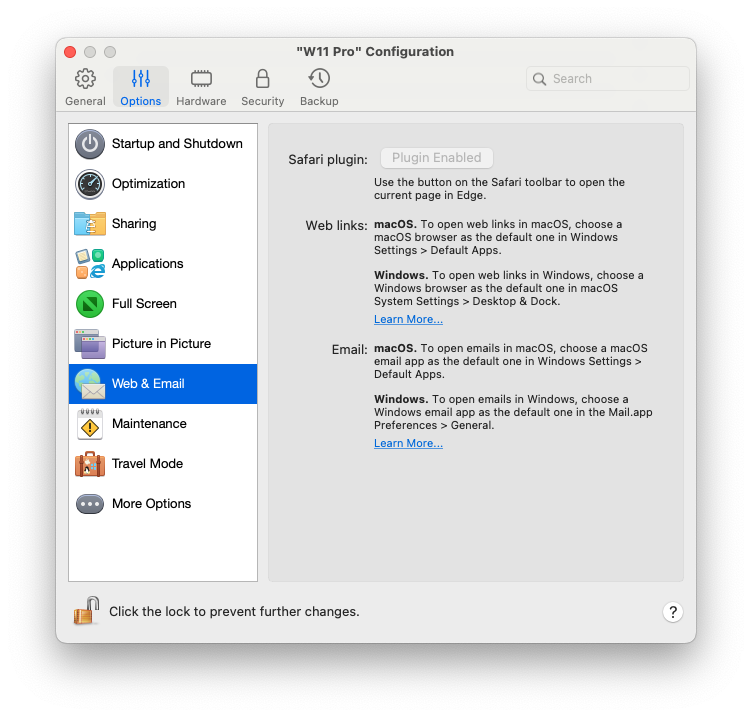
Nel riquadro **Web ed Email**, puoi attivare il plug-in per Safari per aprire le pagine Web in Microsoft Edge. Puoi anche consultare come [configurare i collegamenti e le e-mail che apri in Windows affinché si aprano sempre in un browser Web macOS o app di posta e viceversa](/landing/pdfm-ug/v26-it-it/guida-utente-di-parallels-desktop-per-mac-26/usa-windows-sul-mac/definisci-come-windows-funziona-con-macos/condividi-elementi-tra-macos-e-windows/imposta-i-collegamenti-internet-o-le-e-mail-affinche-si-aprano-sempre-in-macos-o-windows.md).

Per aprire questo riquadro, scegli **Azioni** > **Configura** > **Opzioni**, quindi fai clic su **Web ed Email**.

<figure><img src="https://content.gitbook.com/content/0IDly6Lm0kHvRbywMB0B/blobs/lbW1NIqiid35jDzdBuvw/Screenshot%202024-01-19%20at%2017.29.27.png" alt="" width="563"><figcaption></figcaption></figure>

<table><thead><tr><th width="153">Opzione</th><th>Descrizione</th></tr></thead><tbody><tr><td><strong>Plug-in Safari</strong></td><td><p>Alcune pagine Web funzionano meglio quando vengono visualizzate in Microsoft Edge. Quando utilizzi Safari per la navigazione su macOS, puoi aprire rapidamente la pagina attuale in Microsoft Edge mediante la seguente azione:</p><ol><li>Fai clic su <strong>Attiva plug-in</strong> per abilitare il plug-in "Apri in Edge".</li><li>Una volta abilitato il plug-in, fai clic sul pulsante <strong>Apri in Edge</strong> sulla barra degli strumenti di Safari.</li></ol><p>Windows si avvierà, se ancora non è aperto, mostrando la pagina in Microsoft Edge.</p></td></tr></tbody></table>


---

# Agent Instructions
This documentation is published with GitBook. GitBook is the documentation platform designed so that both humans and AI agents can read, navigate, and reason over technical content effectively. Learn more at gitbook.com.

## Querying This Documentation
If you need additional information that is not directly available in this page, you can query the documentation dynamically by asking a question.

Perform an HTTP GET request on the following URL with the `ask` and `goal` query parameters:

```
GET https://docs.parallels.com/landing/pdfm-ug/v26-it-it/guida-utente-di-parallels-desktop-per-mac-26/preferenze-di-parallels-desktop-e-impostazioni-della-macchina-virtuale/virtual-machine-settings/opzioni/impostazioni-web-ed-email.md?ask=<question>&goal=<user_goal>
```

`ask` is the immediate question: it should be specific, self-contained, and written in natural language.
`goal` is what the user is ultimately trying to achieve, the reason they need the answer. Sharing it helps GitBook give you a better, more relevant answer. A goal is most helpful when it describes the outcome the user wants rather than restating the question. For example, with `ask=how do I create an API token`, a goal like `build a script that syncs our docs to a CMS` lets GitBook tailor the answer to that use case.

The response will contain a direct answer to the question and relevant excerpts and sources from the documentation.

Use this mechanism when the answer is not explicitly present in the current page, you need clarification or additional context, or you want to retrieve related documentation sections.
