> For the complete documentation index, see [llms.txt](https://docs.parallels.com/landing/llms.txt). Markdown versions of documentation pages are available by appending `.md` to page URLs; this page is available as [Markdown](https://docs.parallels.com/landing/pdfm-ug/v27-fr-fr/guide-de-lutilisateur-de-parallels-desktop-pour-mac-27/utiliser-windows-sur-votre-mac/definir-comment-windows-fonctionne-avec-macos/partager-des-elements-entre-macos-et-windows/ajouter-des-disques-windows-au-finder.md).
# Ajouter des disques Windows au Finder
Vous pouvez ajouter des disques Windows au Finder afin que les fichiers Windows soient toujours disponibles.
Voici comment procéder :
1. Tout d'abord, vérifiez que les disques Windows sont partagés avec macOS. Suivez l'une de ces procédures :
* Cliquez sur l'icône Parallels Desktop dans la barre de menus et choisissez **Configurer**.
* Si la barre de menus est visible en haut de l'écran, choisissez **Actions** > **Configurer**.
Cliquez ensuite sur **Options** et sélectionnez **Partage** > **Partage Windows**.
Vérifiez que l'option **Accéder aux dossiers Windows à partir de Mac** est sélectionnée. Si vous souhaitez également partager Windows OneDrive, sélectionnez **Partager OneDrive avec le Mac**.
2. À l'étape suivante, vous devez autoriser le montage des disques Windows sur le bureau macOS. Dans le Finder, choisissez **Finder** > **Préférences**, puis sélectionnez **Serveurs connectés**.
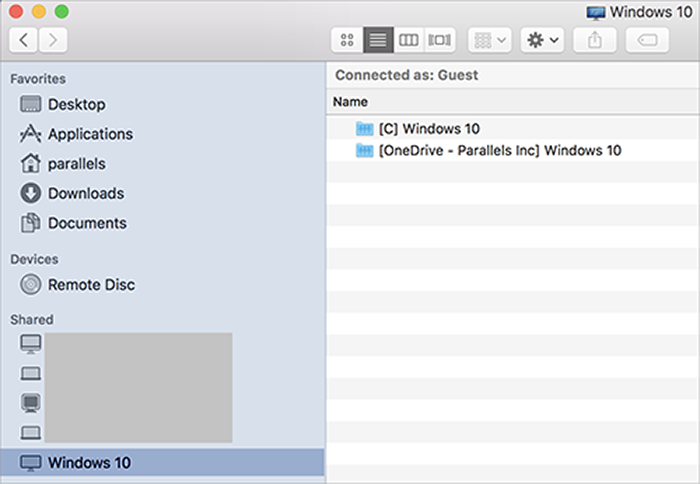
3. Vous devez maintenant monter les disques Windows sur le bureau macOS. Dans le Finder, cliquez sur votre machine virtuelle ; elle doit être disponible dans la section **Partagé**. La machine virtuelle doit être en cours d'exécution.\
\
**Remarque :** dans macOS 10.14 Mojave ou les versions ultérieures, vous trouverez votre machine virtuelle dans la section **Réseau**.\
\
Ensuite, double-cliquez sur l'un des disques Windows. Le disque est monté et s'affiche sur le bureau.
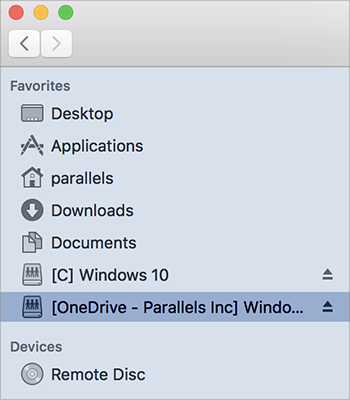
4. Faites glisser le disque depuis le bureau jusqu'à la section **Favoris** du Finder.
Vous pouvez désormais accéder à vos fichiers Windows depuis le Finder macOS.
{% hint style="info" %}
**Remarque :** le disque n'est disponible que dans macOS lorsque votre ordinateur Windows est en cours d'exécution.
{% endhint %}
---
# Agent Instructions
This documentation is published with GitBook. GitBook is the documentation platform designed so that both humans and AI agents can read, navigate, and reason over technical content effectively. Learn more at gitbook.com.
## Querying This Documentation
If you need additional information that is not directly available in this page, you can query the documentation by asking a question.
Perform an HTTP GET request on the following URL with the `ask` and `goal` query parameters:
```
GET https://docs.parallels.com/landing/pdfm-ug/v27-fr-fr/guide-de-lutilisateur-de-parallels-desktop-pour-mac-27/utiliser-windows-sur-votre-mac/definir-comment-windows-fonctionne-avec-macos/partager-des-elements-entre-macos-et-windows/ajouter-des-disques-windows-au-finder.md?ask=&goal=
```
`ask` is the immediate question: it should be specific, self-contained, and written in natural language.
`goal` is what the user is ultimately trying to achieve, the reason they need the answer. Sharing it helps GitBook give you a better, more relevant answer. A goal is most helpful when it describes the outcome the user wants rather than restating the question. For example, with `ask=how do I create an API token`, a goal like `automate deployments from our CI pipeline` lets GitBook tailor the answer to that use case.
The response will contain a direct answer to the question and relevant excerpts and sources from the documentation.
Use this mechanism when the answer is not explicitly present in the current page, you need clarification or additional context, or you want to retrieve related documentation sections.