> For the complete documentation index, see [llms.txt](https://docs.parallels.com/landing/llms.txt). Markdown versions of documentation pages are available by appending `.md` to page URLs; this page is available as [Markdown](https://docs.parallels.com/landing/ras-universal-printing-best-practices/v20/parallels-ras-universal-printing-best-practices/driver-environment-consistency.md).
# Driver environment consistency
Microsoft Spooler Service may become unstable if the terminal server has a very large number of printer drivers installed. Although RAS Universal Printing has no limitations regarding printer types, it is important to protect the terminal servers from printer driver sprawling. In order to mitigate this issue, Parallels RAS Universal Printing includes the printer driver exclusion feature to filter out printer devices that are not needed.
All printer drivers used via Parallels RAS Universal Printing conform to the common Windows printing driver specification and can be managed using standard mechanisms available in Windows.
## **Parallels recommends**
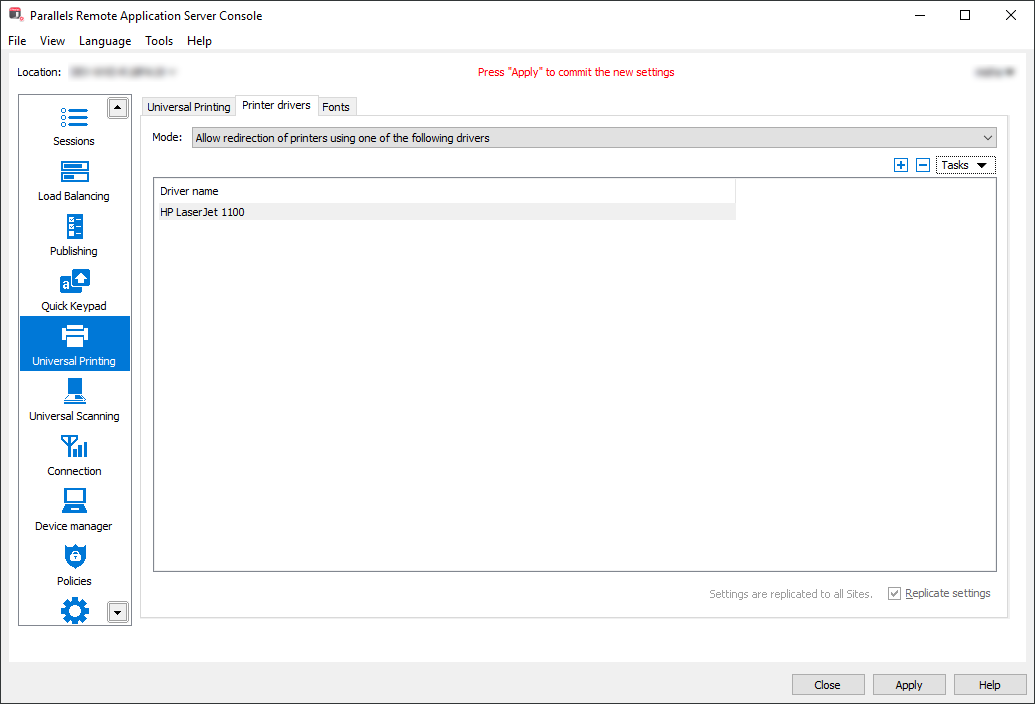
Allow redirection of only the printers that you need and exclude the printers that you don't. This can be done in the RAS console as follows:
1. In the RAS console, navigate to **Universal Printing** > **Printer drivers**.
2. In the **Mode** drop-down list, select one of the following options depending on your preferences:
* **Allow redirection of printers using one of the following drivers** — if you select this option (and specify the driver names in the next step), the printers using the specified drivers will be redirected, while all others will not.
* **Allow redirection of printers which do not use the following drivers** — this option works in the opposite way to the one above.
3. Click **Tasks** > **Add** and then type a driver name. Repeat this step for more drivers if needed.
---
# Agent Instructions
This documentation is published with GitBook. GitBook is the documentation platform designed so that both humans and AI agents can read, navigate, and reason over technical content effectively. Learn more at gitbook.com.
## Querying This Documentation
If you need additional information that is not directly available in this page, you can query the documentation dynamically by asking a question.
Perform an HTTP GET request on the current page URL with the `ask` query parameter, and the optional `goal` query parameter:
```
GET https://docs.parallels.com/landing/ras-universal-printing-best-practices/v20/parallels-ras-universal-printing-best-practices/driver-environment-consistency.md?ask=&goal=
```
`ask` is the immediate question: it should be specific, self-contained, and written in natural language.
`goal` is optional and describes the broader end goal you are ultimately trying to accomplish on behalf of the user. GitBook uses it to tailor the answer towards what is most useful for that goal.
The response will contain a direct answer to the question and relevant excerpts and sources from the documentation.
Use this mechanism when the answer is not explicitly present in the current page, you need clarification or additional context, or you want to retrieve related documentation sections.